How to Sell More at a Farmers Market
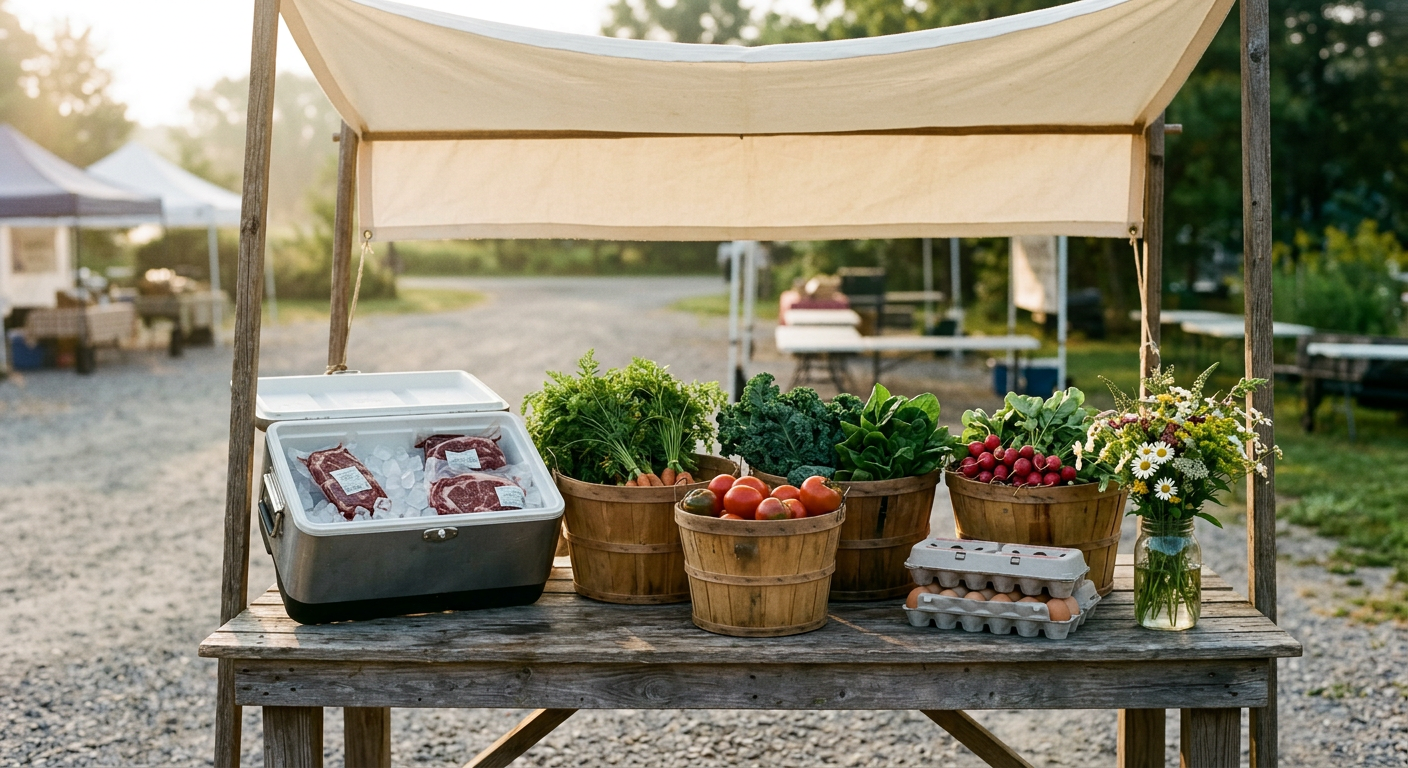
You already do the hard part. You grow honest food, you get up before the sun, and you haul it to a folding table under a white tent. Here is the thing almost nobody tells you: at a farmers market, what you sell matters less than how you show it. The grower with the fullest, most colorful table usually goes home with the empty coolers. This guide walks through exactly how to be that grower.
The short answer: To sell more at a farmers market, build a display that stops people in the aisle, using color, height, and a table that looks abundant instead of picked-over. Price with confidence and put a clear sign on every item. Then capture emails at the booth so today's shopper becomes next week's repeat customer.
There is an old vendor saying that gets right to the heart of it: onions will not get people into your booth, but beautiful carrots will. Both are good vegetables. One is a wall of muddy brown bulbs, the other is a bright orange fan with the green tops still on. Same effort to grow. Very different day at the market. Let's break down how to win that day, whether it is your first market or your fiftieth.
Why does your display decide how much you sell?
Your display decides how much you sell because a farmers market shopper walks a long row of tables and makes a split-second choice about which ones to stop at. You are not really competing on tomatoes. You are competing for the three seconds it takes someone to glance down the aisle and decide your booth is worth crossing the grass for.
Three things do the heavy lifting: abundance, color, and height.
Abundance. A full table reads as fresh and popular. A half-empty table reads as leftovers, even when the food is perfect. The trick most new vendors miss is that you do not need more product to look abundant, you need smaller containers. Use baskets, crates, and bowls that fill up fast and refill often. As you sell down, consolidate onto a smaller table or into tighter baskets so the front always looks stocked. Never let your table look picked-over at 10 a.m.
Color. Colorado State University Extension puts color at the top of its list for a reason. Group your brightest items where the eye lands first, and break up the greens with reds, oranges, and purples. A tower of a single bright vegetable, carrots, radishes, peppers, pulls people in from down the row. If most of what you sell is one color, like eggs or a wall of onions, add color on purpose with a chalkboard, a bunch of flowers, a bowl of tomatoes, or a printed photo of your farm.
Height. Do not lay everything flat on the table where it hides behind the front row and gets bruised. Build up. Use crates, risers, ladder shelves, and crates flipped on their side so your best product sits at eye level. Vertical displays let a small amount of product command a big footprint, and they keep the delicate items off the ground.
Think of it as a tiered display: your signature, highest-margin item goes at eye level in the center, staples fill the mid-level, and bulk or lower-cost items sit lower and toward the edges. You are guiding the eye on purpose, the same way a good grocer does, except your food is fresher and your story is real.
How should you price and sign your booth?
Price with confidence, and put a readable price on everything. The single most common mistake at a farmers market is underpricing, and it quietly costs you all season.
Here is the trap. You worry a higher price will scare people off, so you shave it down to feel safe. But the shopper who drove to a farmers market on a Saturday morning did not come for the cheapest food in town. They came for the freshest food and the person who grew it. When you underprice, you do not win more customers, you just leave money on the table and train people to expect cut-rate prices from you forever. You are selling really nice food. Do not price it like a clearance bin.
A few rules that hold up market after market:
- Never state your price first when someone asks about a big or custom order. Let them ask, then answer plainly. Nervous discounting happens in that pause.
- Price for your margin, not your fear. Processed products like jam, granola, bread, and sauces carry 40 to 60 percent margins, while raw produce runs closer to 20 to 30 percent, according to vendor income data compiled by SmartFarmPilot. If you can add a value-added product, it lifts your whole day.
- Sign everything. Every item gets a clear price sign, common items included. UF/IFAS Extension notes that even familiar items like carrots deserve a sign, because a shopper who has to ask the price often just walks on. Chalkboards, clean printed cards, or a slate with a paint pen all work.
- Let signs do the selling you cannot. A short sign that says how to cook an item, why it is special, or that it is the last of the season moves product while you are busy with another customer.
If pricing is the part that ties you in knots, you are not alone. It is the number one thing farmers ask us about. We built a free pricing walkthrough for exactly this, and our deeper guide on how to price your farm products shows the cost-plus-yield method step by step.
What do you need to sell at a farmers market for the first time?
To sell at a farmers market for the first time, you need a canopy and tables, a way to take cash and cards, the right permits for what you sell, and enough signage to look like a real business. Plan on roughly $800 in startup gear and fees, and keep about four weeks of booth fees in reserve so a couple of slow days do not sink you.
The permit question trips up almost every first-timer, so let's be plain about it. There is no single national farmers market permit. What you need depends on your state and your product, but the pattern is consistent almost everywhere:
- A food permit, only if your product needs one. Whole, uncut produce and many home-kitchen goods are often exempt.
- A cottage food registration or exemption if you make things at home like baked goods, jam, or granola. Cottage food laws vary a lot by state, and states like Tennessee, Ohio, and Georgia are among the lightest for home food makers.
- A sales tax permit, which almost every state requires and usually issues for free.
- Sampling rules, if you plan to hand out tastes. These are worth learning, because sampling reliably lifts sales for food vendors.
Check your requirements through your state Department of Agriculture or your local cooperative extension office before you apply, and apply to the market itself six to eight weeks ahead. Markets often open applications in January or February and fill popular spots early.
Here is the first-timer setup checklist, split into the gear that gets you legal and standing, and the gear that helps you sell:
| Category | What to bring | Why it matters |
|---|---|---|
| Shelter | 10x10 canopy with weights on every leg | Shade, weather, and a defined space. Weights are not optional, a gust will launch an unweighted tent |
| Tables | 2 to 3 folding tables plus tablecloths | Cover the plastic. A clean cloth to the floor hides your bins and lifts the whole look |
| Display | Crates, baskets, risers, chalkboard signs | Abundance, color, and height, the three things that stop people |
| Payment | Cash box with $75 to $100 in small bills and coins, plus a Square or similar card reader | Roughly half of shoppers pay by card. No reader is lost sales. Small bills stop you scrambling for change at 8 a.m. |
| Signage | Farm name banner, price cards for every item, one story sign | People buy from a farm with a name and a face, not an anonymous table |
| Capture | Email signup sheet or a QR code to your list | This is how a one-time shopper becomes a regular. More on this next |
| Permits | Printed copies of your permits and insurance | Many markets check, and you want them on hand |
| Comfort | Water, sunscreen, a chair, layers, trash bag | A twelve hour day starts long before the market opens |
Get the legal and safety pieces right first, then invest in the display. A weighted tent and a food permit are not negotiable. A ladder shelf can wait until week three if it has to.
How do you turn shoppers into repeat and online customers?
You turn a shopper into a repeat customer by capturing their email or phone number at the booth, then telling them what you will have next week. This one habit separates the vendors who grow every season from the ones who start over every Saturday hoping for new faces.
Foot traffic is rented. Your email list is owned. A shopper who loved your peaches today will forget your farm's name by Tuesday unless you give them a reason and a way to remember it. So make the ask simple and make it worth their while.
- Put a signup out where they wait. A clipboard by the cash box or a QR code sign on the table, tied to a short "join our list" offer, works. Something like a dollar off next week or first pick of the eggs gives them a reason to write it down.
- Tell them what is coming. The message people actually want is not a newsletter, it is "here is what we will have at the market this Saturday." Send it once a week. That single text or email drives more repeat sales than any discount.
- Point them to where they can buy between markets. A QR code that links to your online store or order form turns the market into a storefront that keeps selling all week. Vendors who build a list and communicate their schedule consistently out-earn the ones who rely on new foot traffic alone.
The market is the best place you will ever have to build that list, because the customer is standing right in front of you, already holding your food. When they get home and want more, you want them to find you on Google too. Our guide on how customers find your farm on Google covers the "near me" side of the same coin, and if you sell meat, how to sell beef direct to consumers goes deep on turning market buyers into whole and half orders.
What can you do to sell on a slow market day?
On a slow day, work the traffic you have instead of waiting for traffic you do not. You cannot control the weather or the crowd, but you can control your conversion rate, your samples, and your energy.
- Sample aggressively. A slow day is exactly when a toothpick of ripe peach or a spoon of jam earns its keep. Sampling turns a browser into a buyer, and when the aisle is quiet you have time to hand samples out and talk.
- Stand up and engage. Sitting behind the table on your phone reads as closed. Standing at the front, greeting people, and offering a taste reads as open. People buy from people.
- Bundle to move volume. Three bunches for a set price, a "market box" of mixed produce, or a buy-two-get-a-deal moves product before it wilts and lifts your average sale.
- Consolidate the table. As product sells or the day drags, tighten everything to the front and center so you never look picked-over. A full-looking small table beats a sparse big one.
- Feed your list. A slow morning is a fine time to snap a phone photo of your best-looking product and post it, or to add the folks who did stop to your email list. The market is not just today's revenue, it is next week's audience.
One more thing worth hearing plainly: do not judge this business by one slow Saturday. New vendors quit too early, often before word of mouth and repeat buyers have had time to compound. The regulars who make $1,000 days were making $200 days in year one.
How do you stand out when everyone sells the same thing?
You stand out by giving people a reason to choose you that has nothing to do with the product itself, because when five tables sell tomatoes, the tomato is not the tiebreaker. You are.
- Tell your story on a sign. A short board that says who you are, where you farm, and why you do it turns a commodity into a relationship. Farmers Market Coalition's vendor marketing guidance is blunt about this: a farm with a name, a face, and a story wins the shopper standing between two identical tables.
- Look the most abundant and the most cared-for. When the product is the same, the winner is the booth that looks the freshest and the most inviting. That is display, and it is the one advantage you fully control.
- Own a specialty. Be the heirloom tomato farm, the spicy-greens farm, the best-eggs-at-the-market farm. A clear specialty gives people a reason to seek you out by name.
- Be consistent. Show up every week, in the same spot, with the same quality. Regulars build their Saturday around vendors they can count on. Reliability is a marketing strategy.
- Be the human. This is the whole reason a farmers market exists. The strength of a farm is a human being. People drove past three grocery stores to buy from you, so give them you: your name, your hands, your honest answer about how the season is going.
How much money can you actually make at a farmers market?
Most farmers market vendors gross between $200 and $2,000 on a market day, and the range comes down to your product, your market, your display, and how long you have been at it. Beginners in their first year typically bring in $200 to $800 per market day. Established vendors with a loyal following earn $1,000 to $3,000 or more, according to vendor income data from findhomegrown and SmartFarmPilot.
But gross is not the number that pays your bills. After booth fees, gas, packaging, ingredients, and insurance, net profit usually lands between $75 and $350 per market day. That gap is why margin matters so much, and why value-added products and repeat customers move the needle more than raw foot traffic.
| Vendor stage | Typical gross per market day | Typical net per market day |
|---|---|---|
| First-year beginner | $200 to $800 | $75 to $200 |
| Established with a following | $1,000 to $3,000+ | $250 to $350+ |
| Value-added focus (jam, bread, granola) | Higher margin per sale, 40 to 60% | Lifts net across the board |
Set your expectations to the beginner range for your first season, keep those four weeks of booth fees in reserve, and treat every market as a two-for-one: today's cash and tomorrow's customer list. The vendors who last are the ones who understood from day one that the list is worth as much as the sales.
You grow it. We help the world find it.
Here is the honest truth: you are already the hero of this story. You raise real food and you show up every Saturday to sell it face to face. The villain is not your neighbor's table, it is being invisible the other six days of the week. That is the part we fix.
Farm Marketing Engine helps farms and food vendors turn a market crowd into a year-round customer base, with the email capture, the "near me" Google presence, and the weekly "here's what we've got" messages that keep people coming back. You keep your voice and your handshake. We handle the machinery behind it.
- Try the free tool. See what your farm's marketing could look like at Farm Marketing Engine. No cost, no catch.
- Get a free marketing audit. Tell us about your farm and we will show you where the customers are leaking out. Request your audit here.
Frequently asked questions
Do I need a permit to sell at a farmers market? Usually yes, but it depends on your state and your product. Whole, uncut produce is often exempt from a food permit, while home-kitchen goods like jam and baked goods need a cottage food registration. Almost every state requires a sales tax permit, which is usually free. Check with your state Department of Agriculture or cooperative extension office, and apply to the market six to eight weeks ahead.
How much does it cost to start selling at a farmers market? Plan on roughly $800 for your first setup, covering a weighted canopy, folding tables, display crates, signage, a card reader, and your permits. On top of that, keep about four weeks of booth fees in reserve so a couple of slow days do not put you underwater before you find your footing.
How do I attract more customers to my booth? Build a display that reads as abundant, colorful, and tall. Keep your table looking full by using smaller baskets and consolidating as you sell, group your brightest product where the eye lands, and build height with crates and risers so your best items sit at eye level. Then add clear signs and sample generously. Presentation pulls people across the aisle before they ever taste a thing.
Should I lower my prices to sell more? No. Underpricing is the most common and most costly mistake vendors make. Shoppers came to a farmers market for freshness and for you, not for the cheapest food in town. Price for your margin, sign every item clearly, and add value-added products like jam or bread that carry 40 to 60 percent margins. Cutting prices trains customers to expect cheap and leaves money on your table.
How do I get farmers market customers to buy from me again? Capture their email or phone number at the booth, then send one message a week telling them what you will have next market. Foot traffic is rented, your list is owned. A signup clipboard or a QR code tied to a small offer works, and pointing repeat buyers to an online store lets you keep selling between markets.
How much money can you make selling at a farmers market? Most vendors gross $200 to $2,000 per market day. Beginners typically make $200 to $800, and established vendors with a following make $1,000 to $3,000 or more. After booth fees, gas, packaging, and insurance, net profit usually runs $75 to $350 per day. Value-added products and a loyal customer list are what move you from the low end toward the high end.
Want us to get your farm found?
Get a free SEO audit and plan, or try the free tool and get a post in your own words.